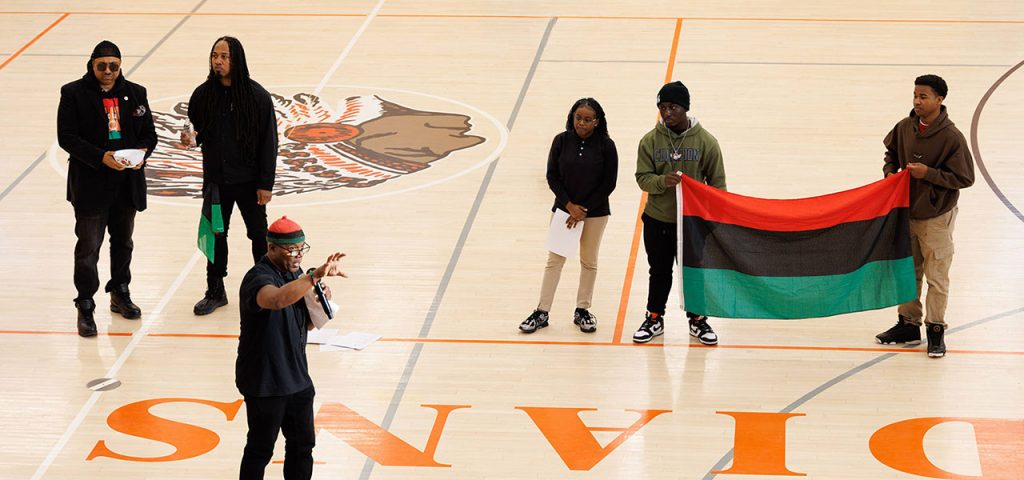
History and Africana Studies Teacher Bashir Muhammad Ptah Akinyele leads the Black History Month opening ceremony at Weequahic High School.
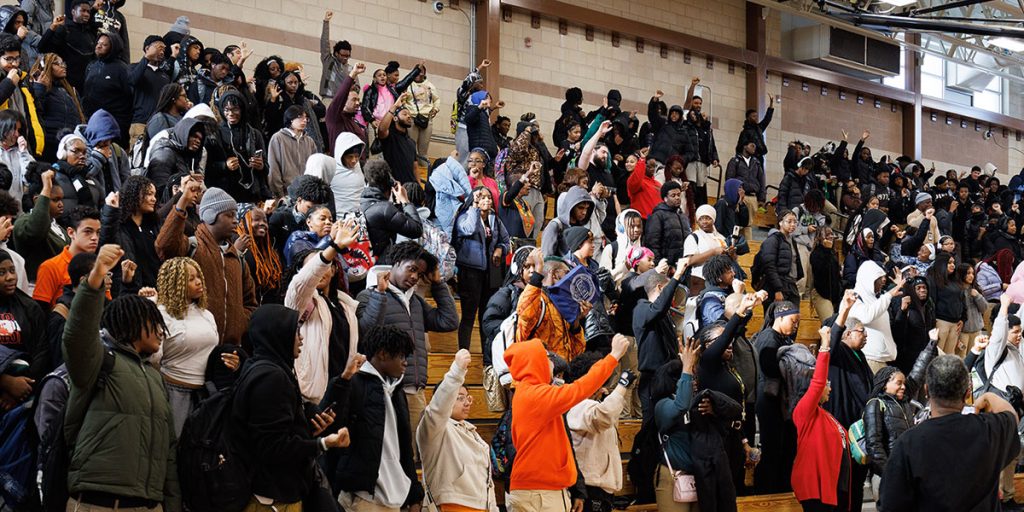
Weequahic High School students and staff participating in the school’s Black History Month opening ceremony.
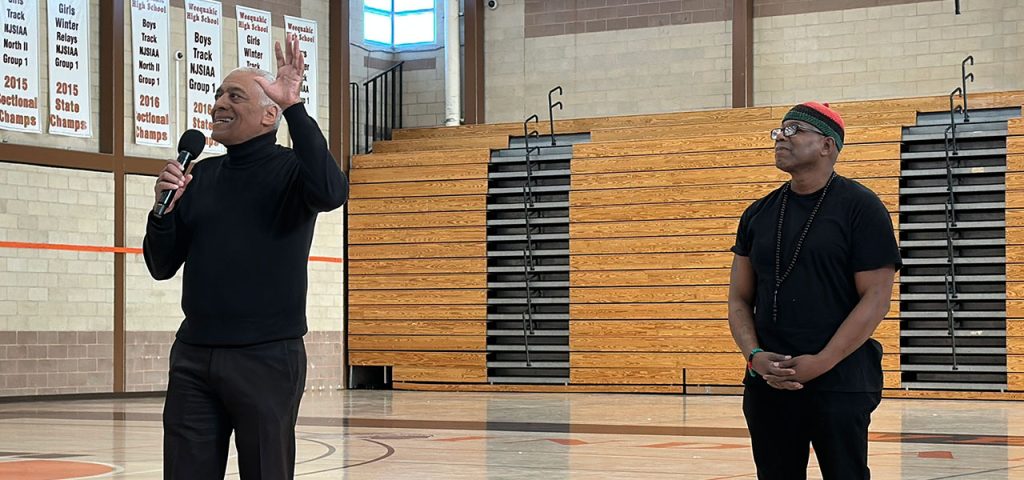
Lawrence Hamm, Chairman of the People’s Organization for Progress, speaks at Weequahic High School’s Black History Month opening ceremony.
NEWARK, N.J. – Students, staff, and community leaders gathered at Weequahic High School for a powerful Raising of the Black Liberation Flag Ceremony to herald the beginning of Black History Month, honoring the historic struggle for educational equity, Black studies, and student voice in the City of Newark.
The ceremony, held on February 2nd, featured remarks from Principal Kyle Thomas, History and Africana Studies Teacher Bashir Muhammad Ptah Akinyele, and Lawrence Hamm, Chairman of the People’s Organization for Progress, whose advocacy as a 17-year-old student activist led to the official recognition of the Black Liberation Flag in Newark schools more than five decades ago.
“Honoring the struggle that brought Black Studies and cultural recognition into our schools reinforces our commitment to ensuring that every student sees themselves reflected in the curriculum and empowered to lead,” said Superintendent León. “I commend everyone at Weequahic High School, and every school throughout our district, in honor of Black History Month and the powerful legacy that the Newark community has contributed to it.”
“As a school district, we are proud that Newark was at the forefront of recognizing the Black Liberation Flag as an educational tool and an affirmation of cultural identity,” said Board of Education President Hasani K. Council. “Weequahic High School’s Black Liberation Flag ceremony affirms that our students are heirs to a powerful legacy of advocacy, scholarship, and pride.”
Honoring a Legacy of Student Leadership
Principal Kyle Thomas opened the ceremony by reminding students of their heritage, resilience, and intellectual legacy.
“We are standing on the shoulders of our ancestors,” Thomas told students. “You are great and beautiful on purpose. Proper education always erases errors. Peace is the absence of confusion, and knowledge is power. Today is another expression of our original Black excellence.”
The Black Liberation Flag – with its colors of red, black, and green – was first adopted in 1921 by the Universal Negro Improvement Association under Marcus Garvey. It became a powerful symbol during the Black Power movement of the 1960s and 1970s.
In Newark, the right to bring the flag into public schools was secured in 1971 after a massive citywide student movement. The flag was proudly raised during the ceremony by juniors Jaden Allicock and James Worwee.
Leeana Chin, also a junior, delivered remarks on the significance of Black History Month, and English teacher Cecelia Blamah-Sah, a member of the Alpha Phi Alpha Sorority, delivered an original poem called, “Embraces.” Other speakers at the event included Dawn Haynes and Sharif Amenhotep of the Brick City Collective and Newark Anti-Violence Coalition (NAVC).
A Historic Newark Victory
Lawrence Hamm, who was the event’s keynote speaker, shared his reflections of that moment in Newark history.
As a senior at Arts High School in 1971, Hamm helped lead thousands of students in organized marches demanding educational reforms, including the right to use the Black Liberation Flag as an educational tool. Shortly thereafter, at just 17 years old, Hamm was appointed to the Newark Board of Education — becoming the youngest voting board member in the United States, a record that still stands.
In December 1971, he introduced the motion that allowed the Black Liberation Flag to be brought into Newark schools as a teaching tool. The measure passed.
“You are not powerless,” Hamm told students during the ceremony. “If you come together, you can make change.”
He reminded students that Newark now allows 16-year-olds to vote in school board elections.
You’re powerful, you’re strong, you’re intelligent, you’re brilliant,” Hamm told the students. “Use the gifts that God has gave you to raise yourself up, but not only raise yourself up, raise up your community.”
Education as Empowerment
The ceremony also included a libation honoring ancestors — a tradition rooted in African cultures — and reflections on the importance of Black Studies as an academic discipline.
Bashir Muhammad Ptah Akinyele, who has taught African Studies at Weequahic High School for more than 23 years, emphasized the educational significance of the moment.
“This is about paying homage to those who paved the way,” Akinyele said. “Black history is deep. Our students deserve to learn it, understand it, and carry it forward.”
A Commitment to Knowledge and Community
Weequahic High School has long been recognized as a leader in Black Studies education in Newark, and the annual flag raising ceremony continues to serve as both a cultural celebration and a civic lesson.
Weequahic’s Black History Month opening ceremony ended with seven Harambe affirmations. The entire school pulled their fists up and down seven times. But on seventh one, everyone held it for a long period of time to call on the spirit of unity and excellence. Harambe is an African Swahili word that means “people pulling together.” Swahili is spoken in many parts of Africa, such as the Democratic Republic of Congo, and Kenya. Swahili is also the language of Kwanzaa.
About Newark Public Schools
The Newark Public Schools is the largest school district in New Jersey and dates back to 1676. The District currently enrolls over 41,000 students in 65 schools. After more than two decades of state operation and upon return to local control in 2018, the District has opened ten new schools under Superintendent León’s leadership with an additional portfolio of new options to be announced in the coming months and years. The Newark Board of Education serves as a beacon of educational excellence, dedicated to nurturing the potential of every student. With a commitment to innovation, inclusivity, and fostering a love for learning, the District continues to shape future generations and make a positive impact within the community.
For media inquiries, please contact:
Paul Brubaker, Communications Director
Email: pbrubaker@nullnps.k12.nj.us
Phone: 973-803-6983